

The Later Work of Pauline Lariviere: “Contemporary Art: Ideally Suited to Medical Illustration”
Abstraction was not a word usually associated with medical illustration in the first half of the 20th century. In the late 1940s, artist Pauline
Larivière made a radical case for principles of contemporary art, like abstraction, to be harnessed by illustrators for the field to evolve in tandem with science and technology.
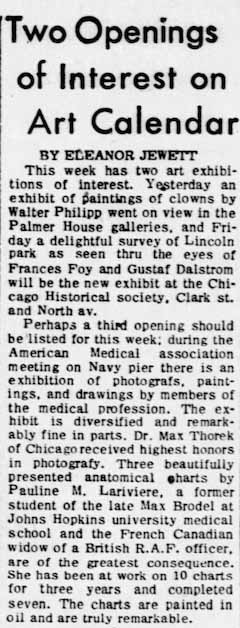
A newspaper article reporting on the Denoyer-Geppert charts, describing them as “truly remarkable.”
Addressing her colleagues at the Sixth Annual Convention of the Association of Medical Illustrators in 1951, she said:
There is a new respect for dissimilarities and asymmetries. This creates a need for other than traditional techniques to illustrate scientific data intelligibly. We, as medical illustrators cannot afford to ignore the trends in modern art technique.
At this time, Lariviere had just completed a collaboration with Dr. Otto Kampmeier to create large-scale anatomy charts in colour, published by Denoyer Geppert (an Illinois-based manufacturer of scientific models, charts, and simulators for teaching). Originally painted in oil using expressive, bold markings, these were reproduced and used in classrooms and laboratories.
According to Kampmeier, Lariviere was “Freed from the shackles of traditional demands” as an artist, and these charts showed tremendous promise as tools for learning.

Pauline Larivière at work in the College of Medicine, Wayne State University, Detroit, Michigan.
The abstraction of the human anatomy and the contrasting colours in these charts made complex medical information legible and accessible. Unlike traditional medical illustration, which would often use specimens as source material, Lariviere depicted organ systems in lively, vibrant colours.
Using cubist methods, she deconstructed and fragmented forms to show more than one view of the body simultaneously. She selectively simplified visual information for clarity, relying on bold design and eschewing crowded text. Instead of labels, an accompanying book was published.
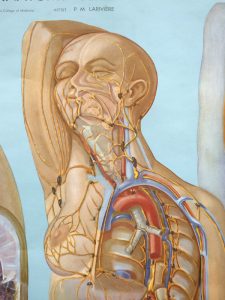
Denoyer-Geppert Anatomy Series, illustrated by Pauline Larivière.
It is perhaps due to both her formal training in Baltimore and in fine arts, as well as her art practice outside of a medical context, that Lariviere was able to develop her innovative approach to these charts. According to the Baltimore Sun, these were the first set of full-sized anatomical charts to be produced in the 20th century and marked a “historical moment.” Little record of Lariviere’s studio practice outside of medical illustration has survived, but her notable work in anatomical charts has continued to be collected by institutions and exhibited into the 21st century.
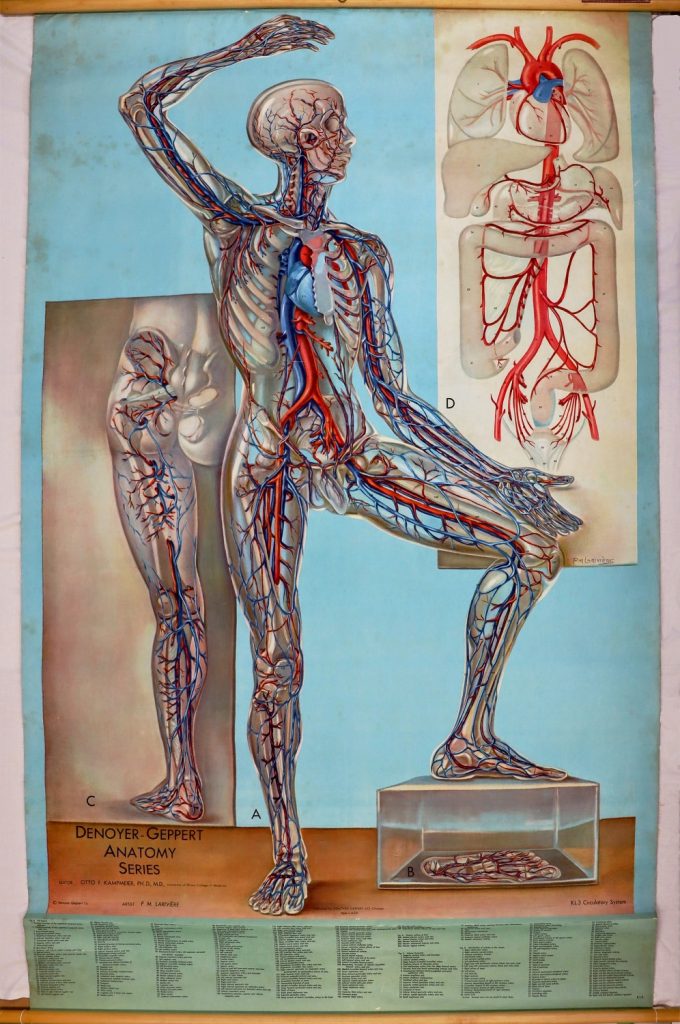
Denoyer-Geppert Anatomy Series, illustrated by Pauline Larivière.
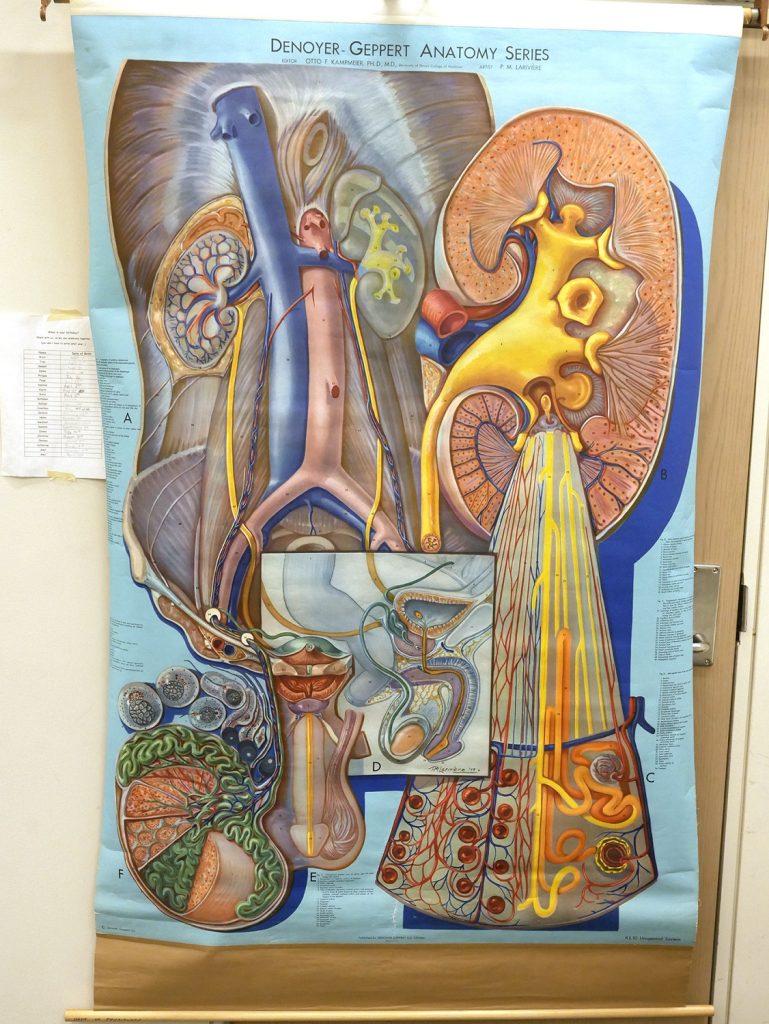
An example of one of the Denoyer-Geppert charts created by Larivière. Here, we see how her use of colour and exaggerated contrast creates distinction between each element.