

A Field Without a Framework
In the early 20th century, medical illustrators worked largely in isolation—often in hospital basements, academic departments, or freelance studios. Without formal networks, they had no reliable way to share ideas or advocate for their work. Women illustrators faced additional barriers: job opportunities were often handed out informally, and professional recognition was rare.

Eleanor Sweezey at work in the operating room, The Montreal Star, 28 January 1957.
In Canada, the situation was especially bleak. Only one medical school—the University of Toronto—had a persistent, dedicated medical art department. Others relied on outdated or poorly drawn images. Institutions claimed they could not afford full-time illustrators, but this excuse rang hollow to professionals like Eleanor Sweezey (1915-2007). She questioned whether medical education could truly succeed without accurate, up-to-date visuals.
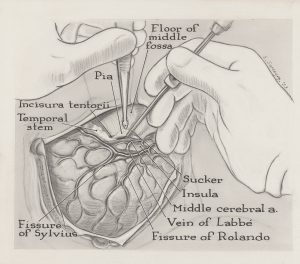
Illustration of a brain by Eleanor Sweezey, 1953
In 1944, a group of American and Canadian illustrators met at the University of Illinois Medical School in Chicago.
Hosted by Tom Jones—who worked there and would become the AMI’s first president—the luncheon included Muriel McLatchie of Massachusetts General, who took a leading role in outreach. Together, they formed a five-member Nucleus Committee, including Maria Wishart of Toronto, to draft a constitution for a new association.
For the first time, illustrators across North America were organizing—and women were at the table from the start.

Illustration of a brain by Eleanor Sweezey, 1953.