

Helen MacArthur — A Steady Hand in a New Era
Helen Turner MacArthur entered the world of medical illustration just as the field was hitting its stride. Born in Toronto in 1920 to American parents with ties to Oberlin College, she grew up surrounded by science—her father was a professor of genetics at the University of Toronto, her mother was a bacteriologist, and her brothers also worked in the sciences. But it was the arts that called to Helen first.
She studied at Oberlin and later the University of Toronto, earning a Bachelor of Arts in practical art. After a brief stint teaching, she discovered something new: a diploma course in Art as Applied to Medicine. It was a perfect fit.
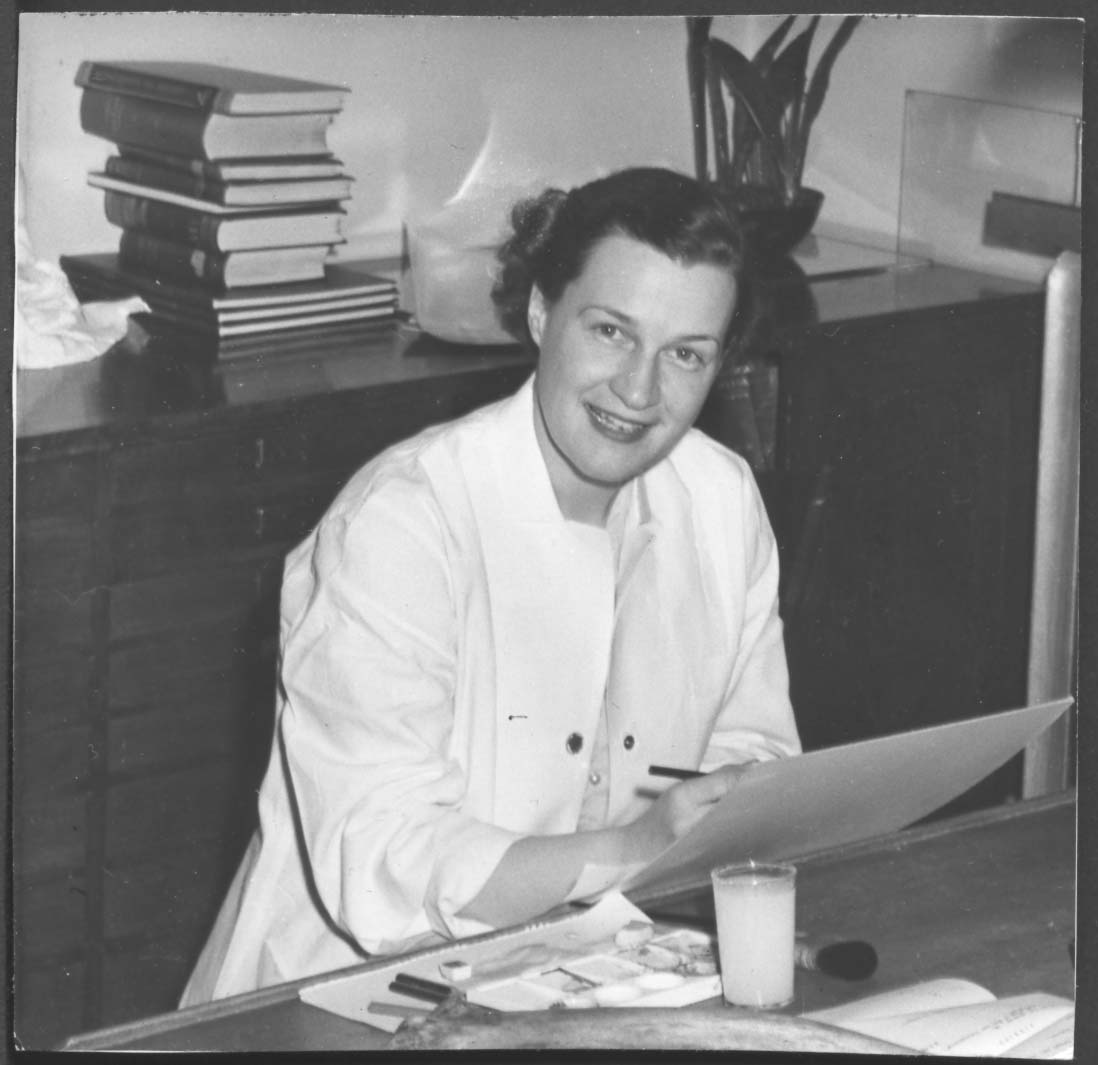
Helen MacArthur in her office at the Royal Victoria Hospital, 1953.
The program had just been launched in 1944 by Maria Wishart, a Canadian student of Max Brödel and one of the founding members of the Association of Medical Illustrators. Under Wishart’s guidance, Helen trained in anatomy and dissection alongside medical students, graduating in 1948. That same year, she accepted a position as head of the Department of Medical Illustration at the Royal Victoria Hospital in Montreal.
MacArthur’s work was calm, careful, and exacting. She sketched at the operating table, standing just behind the surgeon. “I stand behind the surgeon, peer over his shoulder, and sketch furiously,” she once said,
The results may look like chicken tracks, but I go back to my room as quickly as possible to work them out in detail.
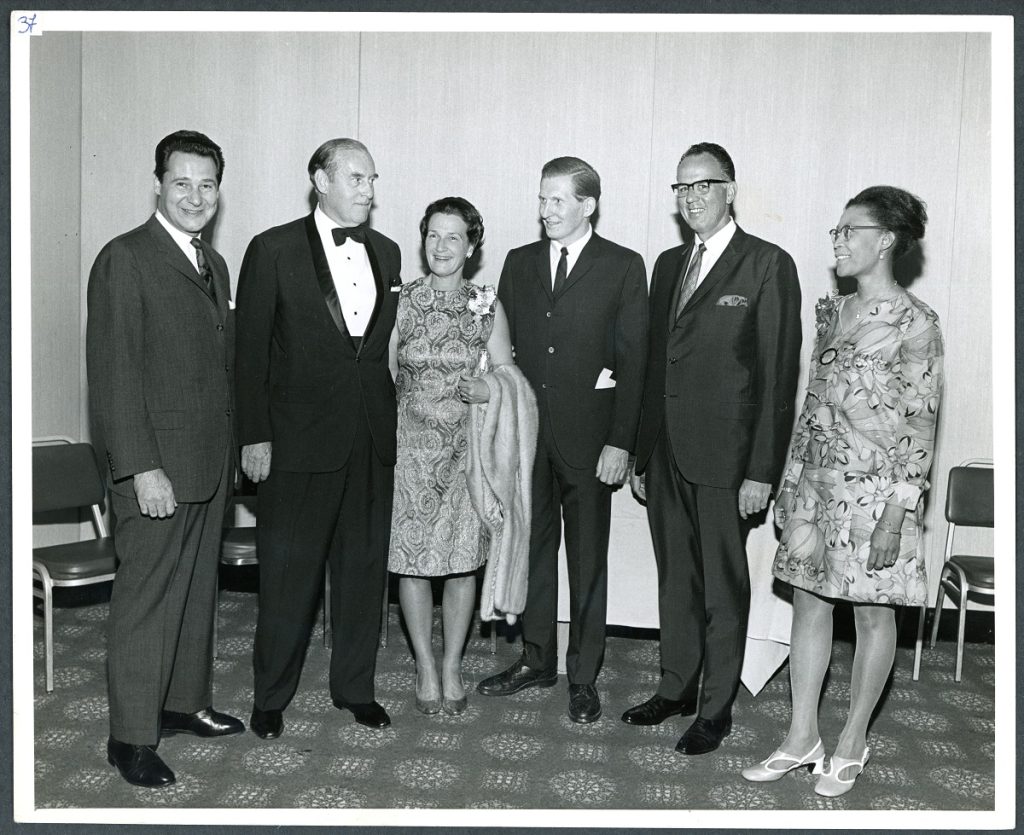
Igor Bitenc, Herbert F. Moseley, Helen MacArthur, John Duff, W. H. Norman, Ernestine McLeod, Accident service group, Royal Victoria Hospital, 1969.
She became a trusted collaborator to RVH surgeon Dr. H. F. Moseley, with whom she worked closely on several major textbooks. Their best-known work, Recurrent Dislocation of the Shoulder, was published in 1961 and became the first book released by McGill University Press. She also worked with Moseley on medical films—an increasingly important tool in surgical education at the time.
Book Launch! Helen MacArthur with J. S. L. Browne, J. Gilbert Turner and Robin Farr, 1961.
Though MacArthur married Moseley in 1964, she didn’t follow the socially expected path of giving up her career. She continued to illustrate and consult well into the 1970s.
Her work was always credited, and her name appeared on everything from exhibition captions to acknowledgments in textbooks. Even in her husband’s obituary, she was recognized as a professional partner: “With the help of his wife, Helen, a medical illustrator, Dr. Moseley wrote or edited 14 publications on surgery.”
MacArthur died in 2006. She belonged to a generation of women who didn’t just enter the field—they helped define it.
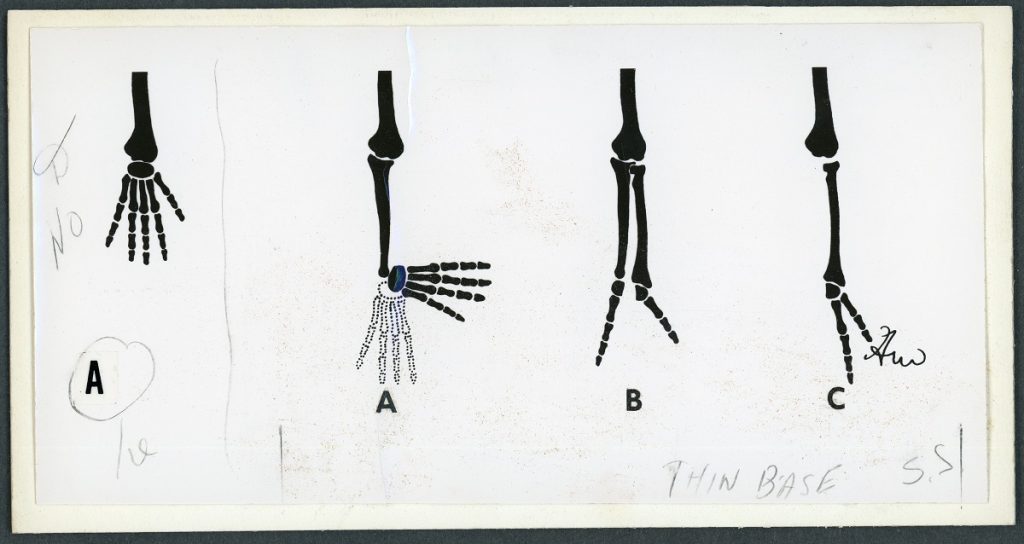
This black and white drawing, annotated with handwritten notes, was a working draft. It offers insight into the artist’s process, showing how ideas were refined and details considered before creating the final illustration.