

A Style Shaped by Science
Lawson’s artistic vision was forged in the operating theatre. She worked in charcoal on chalk-surfaced paper, scratching away for detail, and adding watercolour and crayon for colour work. For microscopic studies, she tinted pale photographic prints while peering through a microscope—an exacting process that revealed her patience and precision.
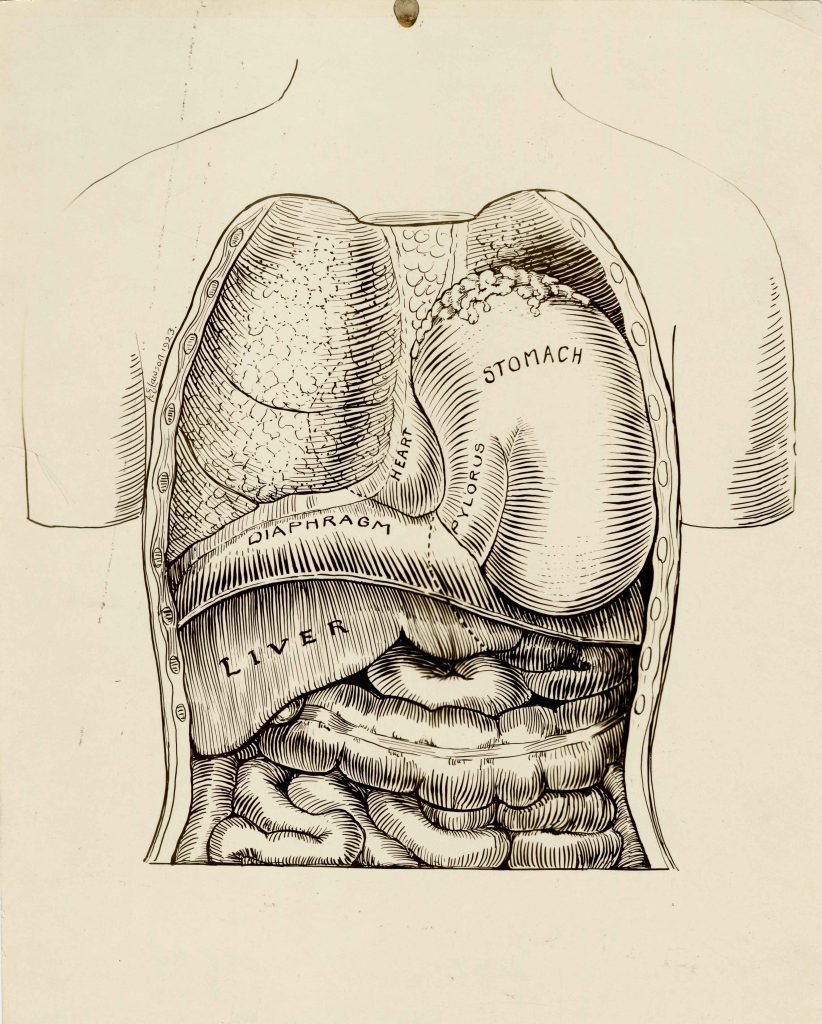
Illustration of internal organs by Nan Lawson, 1923.
This discipline carried into her painting. In 1929, critics noted her “bold forms and sharp contrasts,” praising her ability to strip away the unnecessary and focus on essentials. It was a style clearly influenced by her training as an illustrator, where clarity was everything.
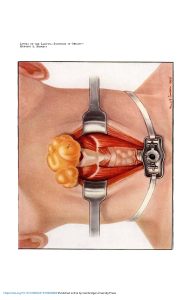
Illustration by Nan Lawson in the Journal of Laryngology and Otology, 1934.
Though she often said she preferred to “paint what I saw, not what the sitter wanted to see,” Lawson moved fluidly between medicine and art.
She studied with J.W. Beatty, Franklin Brownell, Lilias Torrance Newton, Aldro Hibbard, and Alexandre Jacovleff, placing her in conversation with some of North America’s leading artists. She also trained at the École des beaux-arts in Montreal with Edwin Holgate. Her friendships placed her at the center of Canadian art.
In 1927, she met Emily Carr. The two travelled together for years, and Lawson’s portrait of Carr is now housed at the National Gallery of Canada. She also moved in circles with Lawren Harris and Jock MacDonald, members of the Group of Seven.
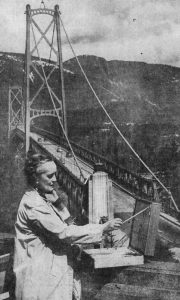
Nan Lawson painting outdoors, The Province, 22 April 1950.
Lawson was one of the rare artists to exhibit both her landscapes and her medical illustrations as fine art. At the University of British Columbia’s Fine Arts Gallery, she displayed surgical diagrams alongside her paintings, asserting their equal artistic value.
By 1961, she was one of only eight medical illustrators in Canada. Yet her influence was wider. She brought the eye of a fine artist to scientific accuracy, and the discipline of medical art to her landscapes.
Her legacy rests not just in the departments she helped build, but in the way she showed that the line between medicine and art was not a boundary—but a shared language.