

North Buxton: Resilience, Legacy, and the Living Memory of Freedom
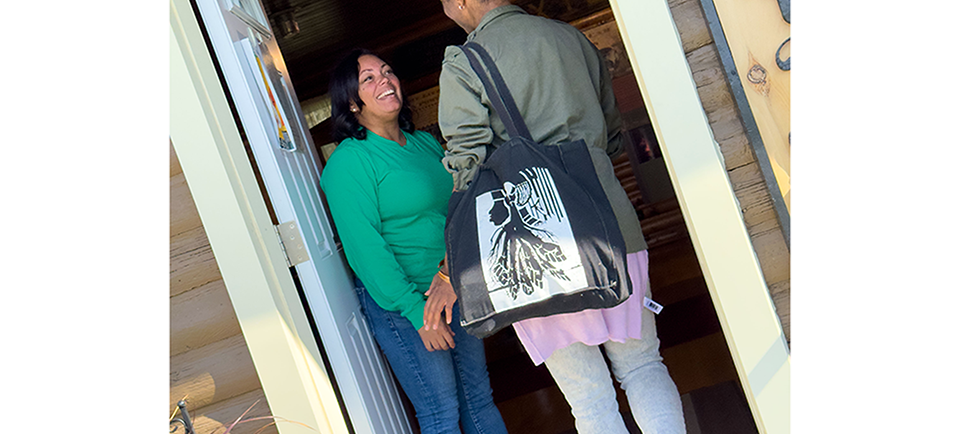
Figure 1. Michelle Robbins welcomed the research team to Buxton National Historic Site & Museum. Photo by Blessing Ogunyemi, taken at Buxton, Ontario, October 2024.
Michelle Robbins is not just a steward of history; she is a living connection to Buxton’s storied past. On both her maternal (Handsor) and paternal (Robbins) sides, her ancestors were freedom seekers who found refuge in Canada through the Underground Railroad. Her family remains one of the descendants still physically connected to the land their forebears made home. One of her forebears (great-great-great-great grandfather), Dennis Calico, was born into enslavement in Tennessee in 1806. Later he was sold to the Robbins plantation and granted freedom under the condition that he marry Jane (the plantation owner’s enslaved partner) and take the Robbins name. Dennis agreed and, in turn, escaped to Canada and settled in Buxton in 1866. Though freed, he chose to retain the surname of his enslaver, transforming it into a testament to his resilience.
Listening to Michelle’s family story invites reflection on the intricate nature of naming during enslavement. The complexity of naming during enslavement underscores both disempowerment and empowerment. While many enslaved individuals were stripped of their identities through forced name changes, freedom seekers often adopted new names to reclaim their autonomy. For example, Ruthie Blackburn changed her name to Lucie Blackburn to reaffirm her liberation. Hence, the Robbins name passed down through generations, serves as a historical marker and a testament to resilience.
In this video, Michelle Robbins speaks on the significance of retaining Robbins’s name.
Why the Robbins Name Matters with Michelle Robbins.
Enjoy this video with an English transcript.
Michelle’s family story also revealed how the experience of enslavement often created complex dualities within families of freedom seekers. This resulted in divisions along racial lines or geographic boundaries, such as those between the United States and Canada. For instance, Harriet Tubman’s family is split into Canadian and U.S. branches. Similarly, the Robbins family embodies this duality, with distinct white and Black family members, some of whom are yet to be discovered. Equally striking is the realization that there are likely family members whose identities may remain forever unknown.
In this video, Michelle Robbins describes what it means for her to be a descendant of freedom seekers via the Underground Railroad.
Michelle Robbins on Her Underground Railroad Heritage.
Enjoy this video with an English transcript.
For Michelle Robbins, who bears a tattoo of the North Star on her hand in honour of her ancestors’ journey, being a descendant of Buxton is more than a point of pride, it is a responsibility. To her, freedom is not just a historical concept but a living, breathing legacy that requires nurturing and safeguarding. Alongside a committed Board and a co-nurturing partnership with the Municipality of Buxton, Robbins preserves and shares her ancestors’ history with unwavering commitment. Through her work at the museum and a rich collection of artifacts, oral histories, and community engagement, she ensures that Buxton’s legacy remains vibrant and invites others to reflect on the meaning of freedom, resilience, and community in their own lives.