

Harriet Tubman: The Prophet of Freedom
When I found I had crossed that line, I looked at my hands to see if I was the same person.
Harriet Tubman, 1869.
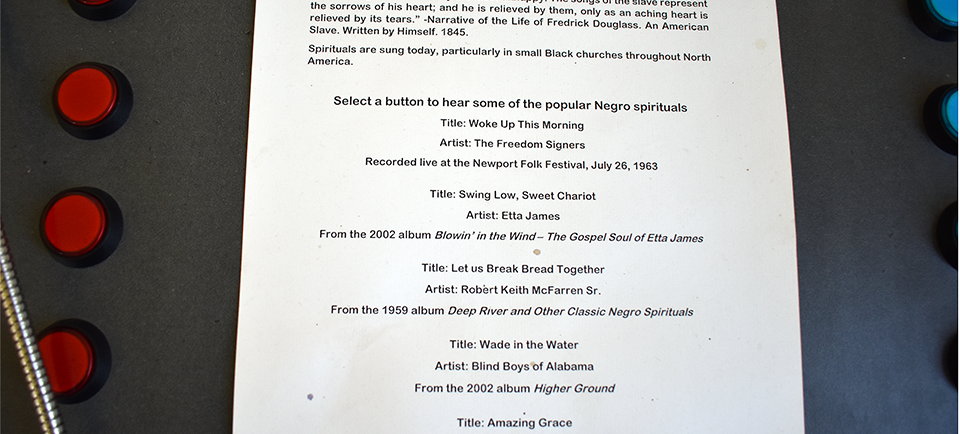
Figure 1. A Picture of the list of the Songs of the Enslaved playing at the Josiah Henson Museum of African Canadian History. Photo by Alex Allasra, taken at Dresden, Ontario, October 2024.
The life and legacy of Harriet Tubman are defined not only by exemplary courage and an unwavering commitment to liberation but also by a profound and abiding faith. For Ms. Tubman, freedom was not just a political condition or a personal prize but a covenant with the divine. The moment she crossed into Pennsylvania, stepping onto free soil for the first time, she felt the weight of bondage lift from her shoulders—the deep, soul-affirming joy of belonging to self. She was free, but she knew, as surely as the North Star had guided her, that her work had only begun.
Freedom, she understood, was not a solitary pursuit; it was a fire meant to spread. Guided by an unshakable spiritual conviction, she believed her liberation was incomplete until all her people were free. And so, driven by faith as fierce as any warrior’s, she turned back toward danger. Over and over, she returned to the land of her captivity, walking straight into the valley of death with only her God and her conviction as armor. “T’wan’t me, ’twas de Lord,” she would say when asked how she found the strength to go back again and again. She spoke of visions, messages from God that lit the way when she was uncertain, that kept her steps sure when others would have faltered.
Dr. Rosemary Sadlier, a Descendant of the Underground Railroad, comments on faith as a central aspect of Harriet Tubman’s life and her relationship with Christianity.
Enjoy this audio with an English transcript.
The wound that should have ended her life—the iron weight hurled at another, but striking her instead, became the very wound that transformed her. The head injury left her with spells of unconsciousness, sudden visions, and moments where she seemed suspended between this world and another. But Ms. Tubman never saw this as an affliction; she saw it as a revelation. These visions sharpened her instincts and told her when to wait, when to move, and when to run. If God had chosen her to see, then she would follow. Her faith was both a refuge and a weapon, allowing her to navigate the most treacherous paths with a spirit that would not be broken and transforming her into a Moses for her people.