

North Buxton: A Living Memory of Freedom
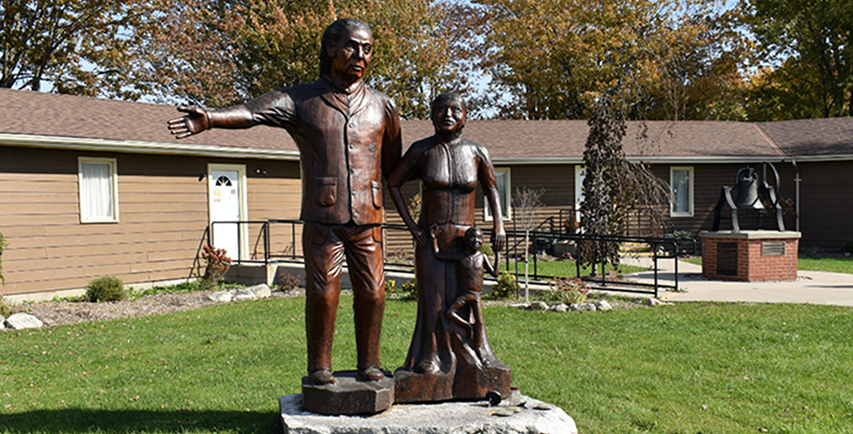
Figure 1. The Sculpture of Reverend William King with Elizabeth (a freedom seeker) and her son, Solomon, whom he bought so that he could come with her, carved out of a rotting tree by a local that stood behind the schoolhouse. Photo by Alex Allasra, taken at the Buxton National Historic Site & Museum, Buxton, Ontario, October 2024.
Beyond its storied past, vast landscape, and pivotal role in shaping Black education and historical achievements in Canada, Buxton is where history breathes and is unerasable. Here, history is not merely preserved; it pulses through the land, is carried on the crisp air, and is woven into the rustling fields that whisper stories of determination and hope. As you step into the Buxton National Historic Site & Museum, the softness and sweet-smelling scent of aged oak mingles with the echoes of those who walked before. Each artifact, each carefully preserved page, holds the weight of memory, honouring the voices of those who dared to dream of liberation. Their presence lingers in every shadow and every quiet corner, inviting you into deep communion—to listen—to feel—to remember—to feel at home.
Driven by an unshakable belief in the potential of Black people to flourish through land ownership and education, Reverend William King, a Presbyterian minister, abolitionist, and missionary, defied fierce opposition to establish the Elgin Settlement (now Buxton Settlement in honour of Sir Thomas Fowell Buxton, a British abolitionist) on November 28, 1849. Among the first settlers were 15 enslaved Africans he had inherited—human lives once bound by chains, now given the promise of freedom. One of them, a young boy rescued from the depths of bondage, stepped onto this land as a free soul. Alongside them was Isaac Riley, one of Buxton’s first Black landowners, who, with his family, helped lay the foundation of a thriving, self-sustaining community.
Although the Settlement’s population declined after the Civil War, the Emancipation Proclamation of 1863, and, more recently, economic demands that led many to move for work, the community’s bond with the land has remained unchanged and unweakened. This admirable relationship, defined by love, tenderness, respect, and renewed belonging, is immediately felt as you step on the land. It is also celebrated and honoured through its yearly Homecoming event, the debut of which was held in 1924.
With its evolution into North and South Buxton, what used to be a predominantly Black community has primarily become a white space. Despite demographic shifts and the evolution of the settlement into North and South Buxton, North Buxton remains a steadfast link to its origins—home to the descendants of those who once fled oppression in search of freedom. At the heart of this legacy stands the Buxton National Historic Site & Museum, an institution dedicated to safeguarding the powerful stories of those who built a thriving community against the odds. Formerly known as the Raleigh Township Centennial Museum, it continues to flourish under the stewardship of curator Michelle Robbins.