

Why Ms. Tubman’s Legacy Still Matters
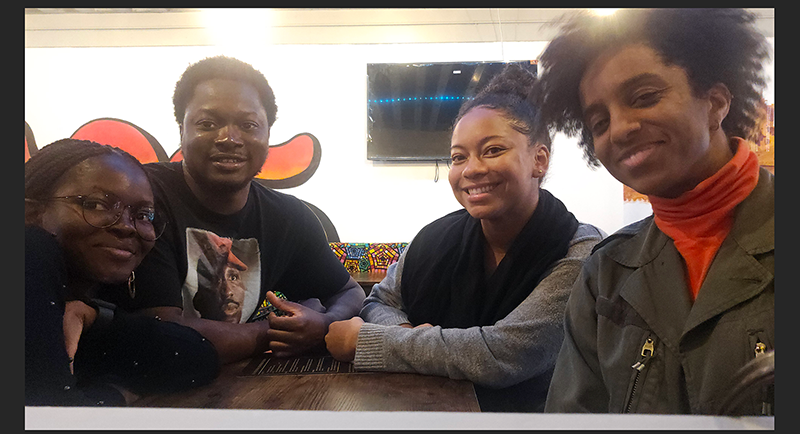
Figure 1. Blessing Ogunyemi, Alex Allasra, Gabriela Sealy, and Emilie Andrée Roumer Jabouin on a lunch break at the Lagos Grill restaurant in Windsor. Photo by the team, taken at Windsor, Ontario, October 2024.
For every enslaved person Ms. Tubman guided to freedom, she was not merely altering one life but seeding generations with the promise of something more. Those who followed her North carried with them the blueprints for communities, families, and futures where Blackness was not a condition to be overcome but a source of power. Today, her legacy reminds us that the struggle for liberation is ongoing. It urges us to resist erasure, to demand more than the crumbs offered, to claim space unapologetically, and to refuse to wait for permission to exist fully and freely.
We are still not far from oppression, and the fight for true equity is far from over. Representation alone is not enough; we must continue to demand equal opportunities in the workplace and beyond. Black visibility should not be mistaken for Black liberation. It is not enough to be seen; we must be empowered, resourced, and given space to thrive.
Dr. Rosemary Sadlier powerfully addresses the ongoing reality of racism, emphasizing that despite progress, racist dehumanization persists, and the fight for true equality continues.
Enjoy this audio with an English transcript.
To fully grasp Ms. Tubman’s impact, we must see her not just as an American or Canadian hero but through the lens of what scholar Dr. Emilie Jabouin calls Afro-Northern-ness. This concept speaks to the realities of Black communities who moved between the United States, Canada, and the Caribbean in search of freedom, security, and prosperity. This expanded Northern world was more than just a destination; it was a dynamic and evolving region of Black resistance, shaped by migration, survival, and creolisation.
By recognising Ms. Tubman as an Afro-Northern figure, we free her legacy from the limits of singular national narratives and embrace her transnational legacy, a testament to the necessity and power of movement in the fight for freedom. She belongs not to one country but to all who fight for freedom. She is a symbol not just of the past but of the power of movement, the resilience of the displaced, and the relentless spirit of those who refuse to accept oppression as their fate.
In a world that still seeks to diminish Black voices, Ms. Tubman’s story is a call to action. Her life was not just about escape but progression—forward, upward, beyond. This lesson must be inherited by Black children, not just in textbooks but in the fabric of their everyday understanding of what is possible. Teaching her story is to do more than recount history; it is to arm the next generation with the knowledge that they, too, are history in the making.