

Techniques that have evolved
Fishers no longer use the Kamouraska Islands as their home port. They prefer to fish in the St. Lawrence River or on the banks and mudflats opposite the islands. Like most fishers, the Ouellets use fixed fishing gear, taking advantage of the movement of the tides and the expanse of the tidal flats.
Fixed enclosures allow the following fish to be trapped during ebb tide: herring and shad in May, sturgeon from late May to early July, and eel from late September to late October.

Flavius Ouellet in front of a fish weir at Île aux Patins in Kamouraska.

Reconstruction of a fish weir.
These Installations have evolved over time. In the past, fish weirs were built by weaving alder or birch branches onto stakes to form a long fence made of two parts extending into the water: the leader, a long hook-shaped enclosure about a kilometre and a half long, formed of some 2,000 stakes between which were intertwined a few branches of coniferous trees and branches of alder; and the bowl, a circular enclosure into which the leader directed the fish, which were then collected by the fishers. They went to their installations on horseback at low tide to collect their catch. Île aux Patins was the site of one of the largest weir fisheries in Quebec.
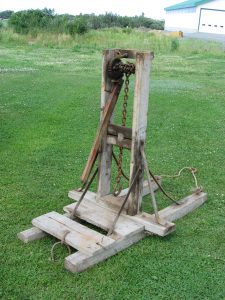
Stake puller.
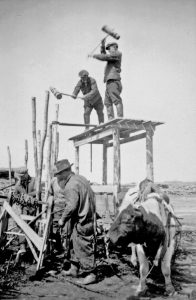
Building a fish weir in 1936.
Building a fish weir was difficult and had to be repeated every year. During an interview with anthropologist Marius Barbeau in the 1940s, Flavius Ouellet explained that he began working on his fishing installations in mid-April and dismantled them before All Saints’ Day (November 1). The work also involved replacing the stakes every year, as they had a lifespan of about five to six years.
During their sixty years of fishing on Île aux Patins, Flavius and Maurice Ouellet received help from local farmers who needed fish to fertilize their soil.

Fish weir at the island.