

Making Waves
Why don’t we sail a boat up there and confront the bomb?
The year 1971 witnessed a different kind of protest journey, not by land, but by sea. Over international opposition, the U.S. government had announced that it intended to test nuclear weapons at Amchitka Island off Alaska, risking environmental disaster as well as escalating the arms race. In British Columbia, a loose group of activists called the ‘Don’t Make a Wave Committee’ was trying to think of ways to stop the planned test. One of the group’s members, Marie Bohlen, threw out an idea: “Why don’t we sail a boat up there and confront the bomb?”
It was a wild and improbable idea, but it caught the group’s imagination. The organization was somewhat chaotic, but in the end, they had acquired an old boat, the ‘Phyllis Cormack’, and a crew of 12 set off for Amchitka. They decided to change to name of the boat to something that reflected their goals, and so the Phyllis Cormack became the ‘Greenpeace.’
Later accounts of the voyage by members of the group paint a picture of conflict and chaos. In the words of one participant, “Here we were, supposedly saving the world through our moral example, emulating the Quakers, no less, when in reality we spent most of our time at each other’s throats, egos clashing, the group fatally divided from start to finish.”
But – despite the negatives, and against expectations, the venture turned out to be a success. International media coverage incited people from all over the world to get involved with environmental and peace movements. The Americans went ahead with the planned test, but then announced that they would undertake no further tests at Amchitka.
The organization launched by the voyage, Greenpeace, born in Canada, became a major and high-profile force in the international environmental movement, and is still influential 55 years later.
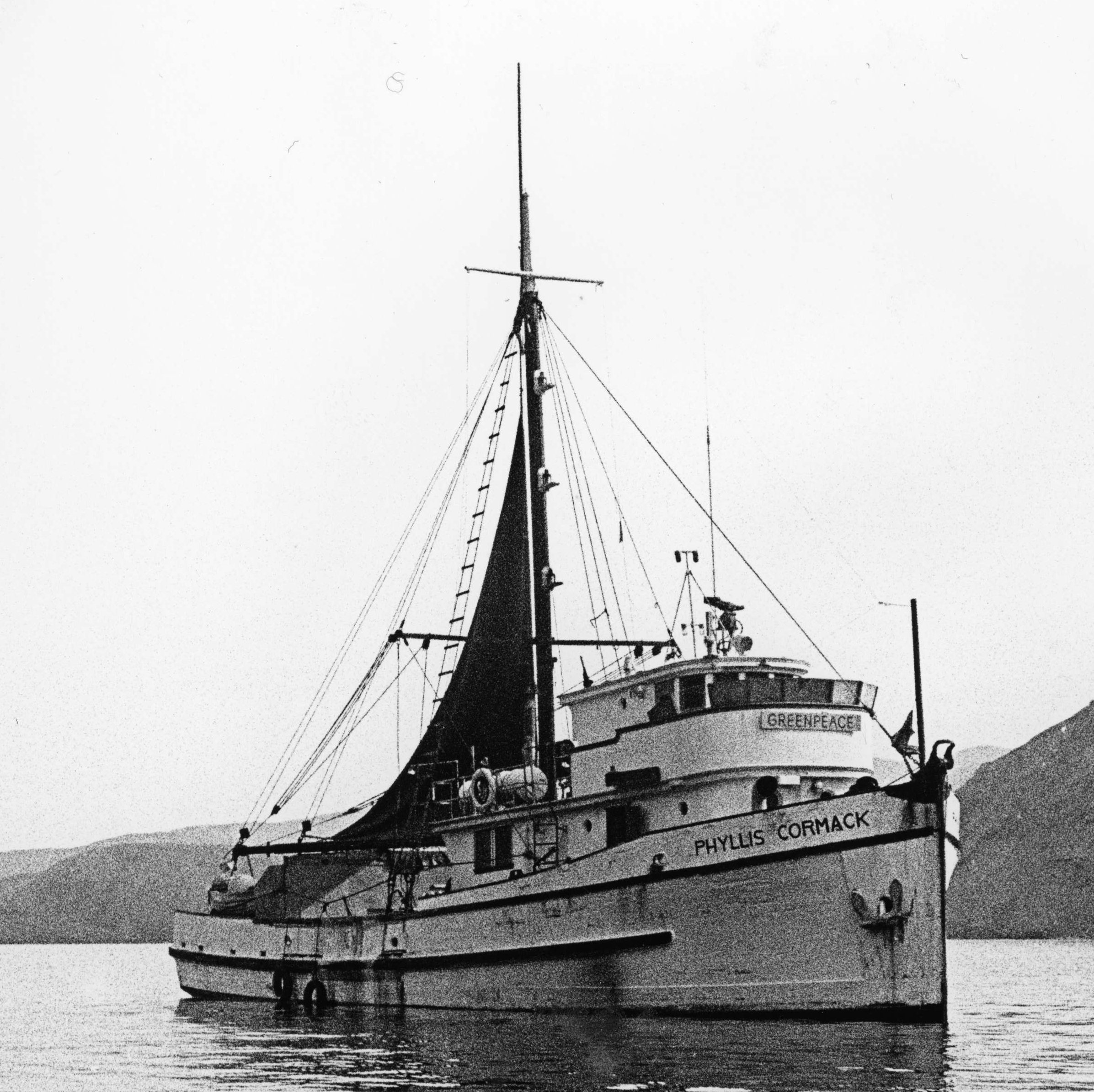
The halibut trawler “Phyllis Cormack”, later renamed “Greenpeace”