

Monument Honouring Women in Politics, in Front of the Parliament Building in Quebec City
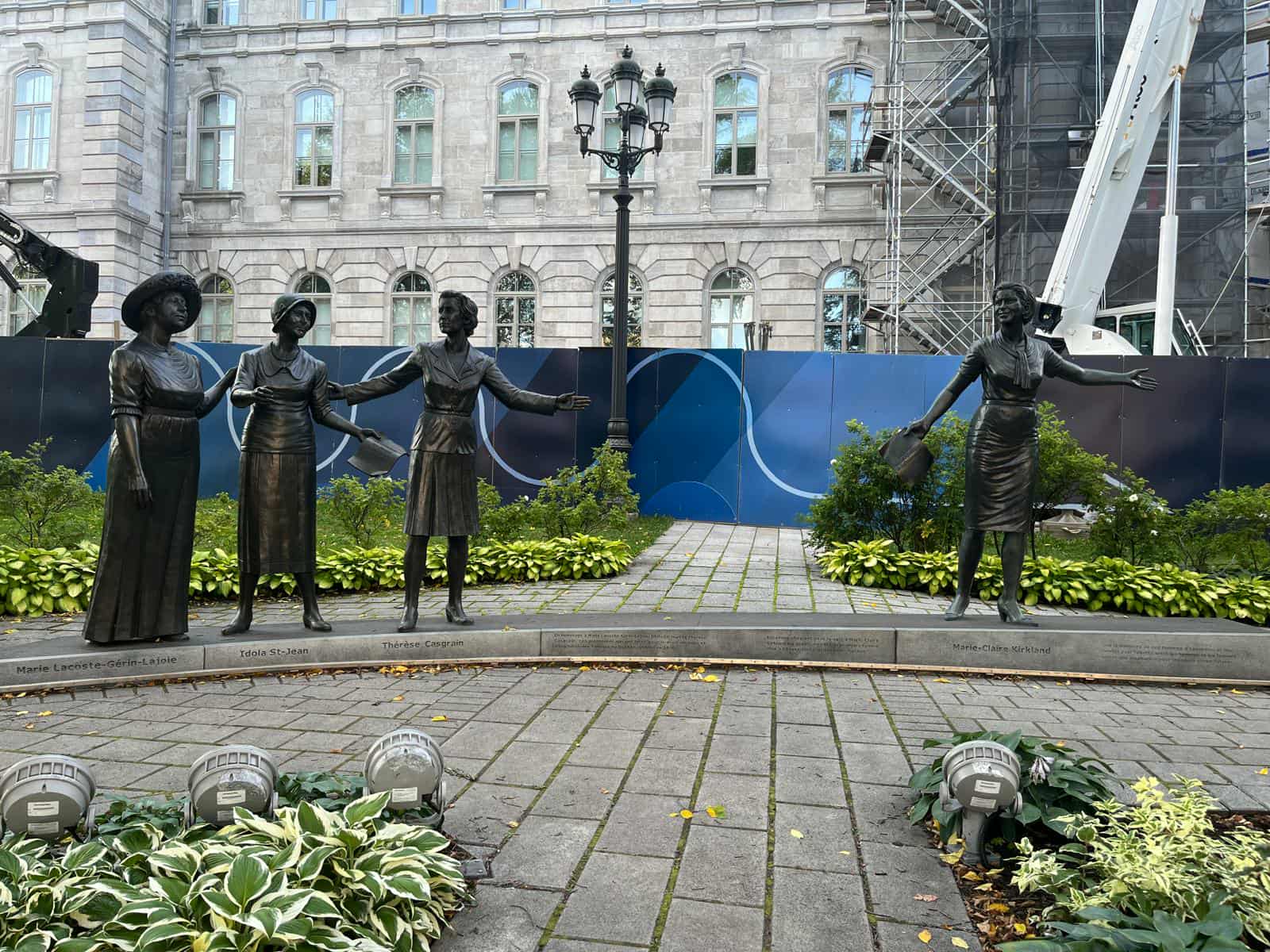
Marie Lacoste-Gérin-Lajoie, Idola St-Jean and Thérèse Forget-Casgrain, members of the Comité provincial pour le suffrage féminin (Provincial Committee for Women’s Suffrage), which was founded in 1922. On their right is Marie-Claire Kirkland, the first Quebec woman to be elected as a provincial legislator (1961) and to serve as provincial premier (1962). They had all been staunch defenders of women’s rights.
The first wave of feminism in Quebec saw the emergence of a large number of women’s organizations between 1910 and 1940. These included a rural women’s association known as the Cercle des fermières. As with first-wave feminist movements in other Western countries, the demands of French-Canadian women reflected a maternalistic outlook. In other words, they saw women’s empowerment as a means of better fulfilling their roles as wives and mothers. Driven by the power of collective action, organizations like the Comité provincial pour le suffrage féminin joined forces to demand voting rights for women. By 1918, they had succeeded in securing the right to vote in federal elections.
However, support for women’s suffrage was far from unanimous in Quebec society. Strongly influenced by the Catholic Church, leading currents of public opinion opposed giving women the vote because it was seen as putting the needs of women above those of men. At the time, social conventions largely confined women to the domestic sphere, where they were expected to play the traditional roles of mother and homemaker. That meant exclusion from political life, and Quebec women continued to be denied the right to vote in provincial elections. It was not until 1940, when Adélard Godbout was serving as premier, that sustained efforts by universal suffrage advocates finally bore fruit.