

Printing

Type case used to print The Fisherman’s Advocate newspaper, Port Union, Newfoundland
Print, which lends itself to an almost-infinite variety of formats – newspapers, pamphlets, books, broadsheets, magazines, stickers, leaflets, posters, maps, signs – has played a crucial role in communicating political message for centuries, and continues to do so.
There are many ways of getting ink onto paper. Some are complex and expensive, requiring the organization that wants to use them to employ the services of a professional printshop. But there are and were simpler and cheaper options, accessible to groups with modest resources and a certain degree of ingenuity.
The versatility of printing extends to its ability to be applied to a wide range of media in addition to paper, including cloth, wood, and plastic. Printing techniques were in use in Korea and China for centuries in the decorative arts, but it was Johannes Gutenberg’s invention, in the 1450s, of mechanical moveable type which could be mass-produced in the quantities required to print whole books, as well as his development of a mechanical printing press and oil-based inks, which revolutionized printing.
The religious and political upheavals which erupted in Europe in the early 1500s may not have been caused by the printing press, but it was the printing press that made them possible. Dissenting opinions which previously could only have been communicated by word of mouth, could now be printed and disseminated in large quantities. In the following centuries, religious and political debates were fought out with competing pamphlets and broadsheets which reached a wide reading public.
The association of printing and political advocacy travelled across the Atlantic to Britain’s colonies in North America. An early example in what was then Upper Canada was William Lyon Mackenzie’s newspaper The Colonial Advocate, harshly critical of the ruling ‘Family Compact,’ which began publication in 1824. Mackenzie’s hard-hitting editorials enraged members of the Family Compact to the point that, in 1826, they broke into the newspaper’s premises, wrecked the office, and threw the type used to print the paper into Lake Ontario. Mackenzie responded by suing the perpetrators: he won the case and a jury awarded him damages which allowed him to buy a new printing press.
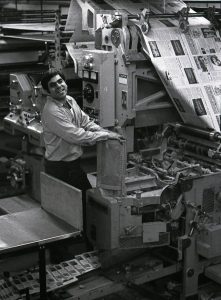
Printing a community newspaper on a web offset press, 1980.
For the most part, small groups of activists did not have the resources to buy and run their own printing press, so they relied on commercial printers to produce their publications. The cost of doing so, and the real risk that a commercial printer might refuse to print a publication if he didn’t agree with its politics, led activist groups which could raise the money to do so to buy a small stencil-based press or mimeograph which they could operate themselves. These machines could not match the quality of a professional press, and they were limited to relatively small press runs, typically a few hundred copies at most. But they could be run in a back room or basement, and some of them were hand-operated, meaning that they did not even require electricity. The stencils could be produced with a typewriter.
The 1960s and 1970s saw the emergence of a number of ‘movement’ print shops which were launched to provide activist groups with printing and related graphic arts services. These print shops, non-profit and typically run as worker-owned collectives, became a mainstay of activist print production.