

On the Road
Going out into the streets has always been one of the main tactics that activists have used to publicize their cause. Demonstrations and marches are visible, often loud, and an opportunity to engage with people on the street.
While such actions can and do take place almost anywhere, there are times when activists see it as particularly important to make their presence felt in the places where decisions are actually made. In Canada, that often means Ottawa, or a provincial capital.
The Abortion Caravan
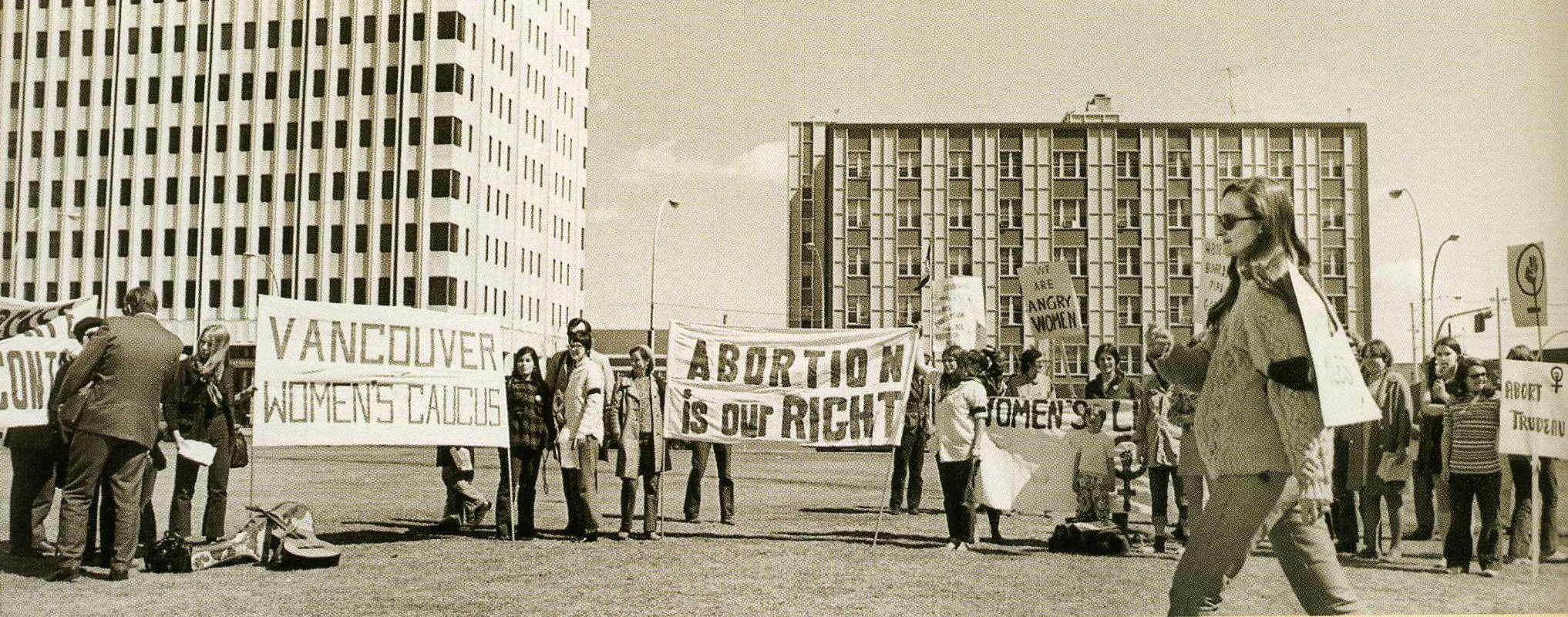
Abortion Caravan.
In 1970, abortion was the flashpoint that sparked another protest movement headed to Ottawa. Many women were profoundly dissatisfied with the abortion legislation the federal government had passed in 1969. The new law allowed abortions only under very restrictive conditions. The Vancouver Women’s Caucus, a New Left women’s liberation group, came up with a plan to set out in an ‘Abortion Caravan,’ emulating the 1935 On-to-Ottawa Trek, with the goal of publicizing the pro-choice cause and gathering more supporters on the way.
In April 1970 a group of women set out from Vancouver in a yellow convertible, a pickup truck, and a Volkswagen bus with a black coffin strapped on the roof. As they crossed the country, they stopped in communities on the way to hold public meetings, put on guerilla theatre performances, and listen to women’s stories.
The Abortion Caravan arrived in Ottawa on Mother’s Day weekend 1970. A convoy of Canadian women, over five hundred strong in support, arrived — coat hangers and a black coffin in tow — to demand the legalization of unrestricted access to abortion services for all Canadian women. When Justice Minister John Turner said that there would be no changes to the law, some three dozen women entered the visitors’ gallery, chained themselves to their seats, and disrupted the house of Commons. It was the first time in the history of the House of Commons that the Commons was forced to shut down because of a protest. The event generated nation-wide media coverage.
The Abortion Caravan did not lead to immediate change, but it had a powerful impact in making the issue visible and galvanizing support.
The Native People’s Caravan
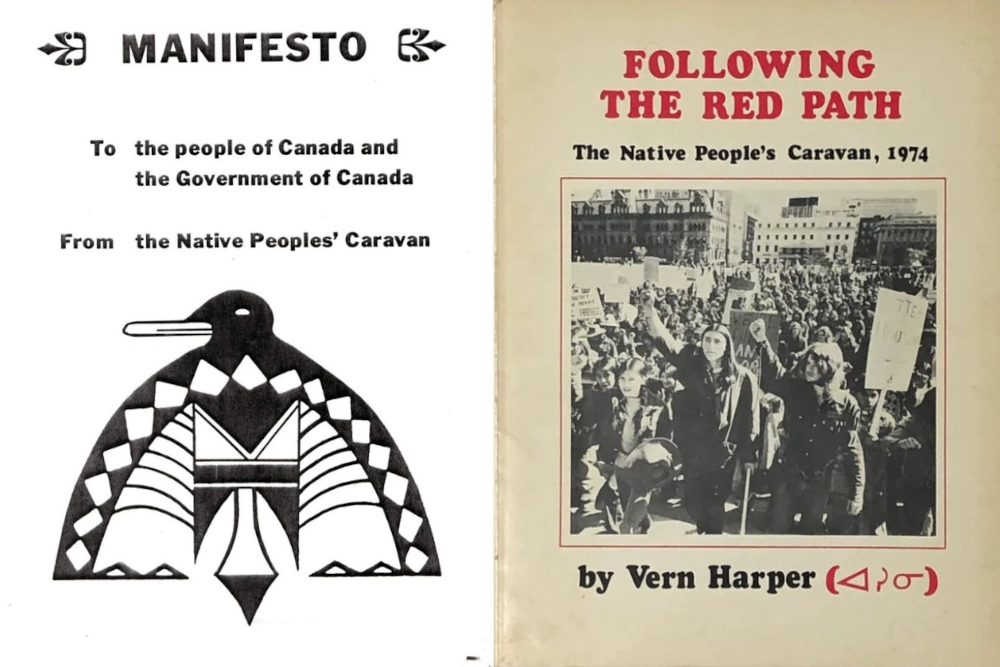
The Manifesto of the Native People’s Caravan laid out the grievances and demands of Native Peoples. Vern Harper, one of the leaders of the Caravan, later wrote a history of the Caravan: Following the Red Path.
The 1960s and early 1970s were a time of heightened indigenous activism, and new ways of getting attention and results were being explored. In 1974, this led to the Native People’s Caravan, a cross-country protest starting in the west and heading toward Ottawa.
The Native People’s Caravan was seen as a way to unite Indigenous rights movements, publicize the problems faced by Indigenous people throughout the country, and bring the demands outlined in the Caravan’s manifesto directly to the federal government.
Travelling in rented buses, the Caravan left Vancouver on September 15, 1974, and began its journey to Ottawa along the Trans-Canada Highway. Along the way, it stopped in various cities to hold rallies, raise funds, and increase its numbers. As it travelled, the Caravan grew, and by the time it reached Ottawa it comprised approximately 200 participants.
On September 30, 1974, the approximately 200 Caravan participants gathered on Parliament Hill, joining roughly 300 other supporters. Though unarmed, they were met with barricades and a wall of RCMP officers at the bottom of the steps to Parliament.
Although government representatives refused to meet with the Native People’s Caravan, and its demands were not met, the Caravan attracted significant media attention and raised public awareness of the struggles of Indigenous peoples. The Caravan is recognized as having helped to lay the foundation for future Indigenous political movements.