

Radio
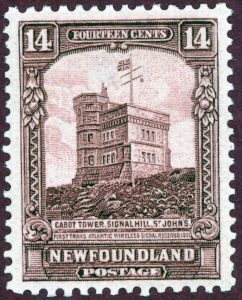
A postage stamp from Cabot Tower, Signal Hill, St. John’s which commemorates the first transatlantic wireless signal received in 1901.
The Italian inventor Guglielmo Marconi began investigating the idea of creating long-distance wireless transmission systems based on the use of radio waves in 1894. His initial idea was to make telegraphic communication possible without the use of cables or wires. Several years of work allowed him to transmit signals over ever-greater distances until, in 1901, he was able to send a test signal from Britain to Signal Hill in Newfoundland: the first trans-Atlantic transmission of radio signals.
The prolific Canadian inventor Reginald Fessenden was working on a more sophisticated system, with the goal of transmitting not only telegraphic signals, but words and music. In late 1906, he alerted radio operators on ships off the northeastern seaboard to tune in for a special transmission on Christmas Eve. When they did so, they heard, not the usual pattern dot-dash-dot of telegraphic signals, but words and music: Fessenden playing O Holy Night on the violin, and reading a Bible passage.
Radio broadcasting in the modern sense began in Canada in the early 1920s, with the establishment of the first radio stations under a system of regulation that assigned separate broadcast frequencies to different stations. These early commercial stations were not available to activist groups, which did not have the resources to fund and operate stations of their own, even if government regulators had been willing to allow them to do so.
It was only with the creation of the Canadian Radio Broadcasting Commission in 1932 that radio stations funded by taxes, with a mandate of serving the public interest, became part of Canadian society. Increasing concern about private stations in Canada falling under American ownership played an important role in this crucial step, which was then followed by the creation, in 1936, of the Canadian Broadcasting Corporation (CBC) / Radio Canada as a Crown corporation.
This Canadian approach to telling Canadian stories through publicly funded institutions extended, in the years that followed the creation of the CBC, to the creation of the National Film Board in 1939, and then CBC Television in 1952. These publicly funded media created space for broadcasts that dealt with social problems and social alternatives, and stimulated public discussion.
The CBC stands as a typically Canadian way of encouraging media working in the public interest. Recognizing that privately owned stations dependent on the favour of advertisers could not be counted on to reflect the interests of Canadians, Canada took the bold step of entrusting the job to a publicly owned corporation, funded by the government but insulated from direct government interference. A number of provinces, including Quebec, Ontario, and British Columbia, followed suit by creating their own provincial broadcasters, with similar mandates, but focused on a province rather than the whole country.

From 1922 to 1953 individual members of the public were required to pay for annual Private Receiving Station licences in order to legally receive broadcasting stations.