Family Stories - A Culinary and Agro-Food Heritage to Discover Family Stories - A Culinary and Agro-Food Heritage to Discover Musée québécois de l'agriculture et de l'alimentation
Arranged on a simple surface, these prints on a black background highlight the form, texture, and singularity of each specimen.
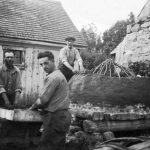
Men from Saint-Denis-De La Bouteillerie building a bread oven in 1936. Many households baked this daily staple in their own oven.
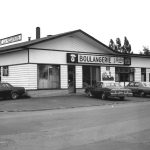
La Pocatière bakery shortly after moving into its new premises in 1972.
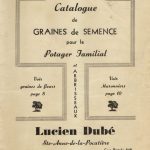
Starting in spring 1945, Lucien Dubé operated a vegetable and flower seed business. The seeds were imported products that had become scarce due to the war, and were […]
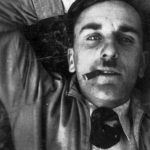
Born on May 2, 1911, in Sainte-Anne-de-la-Pocatière to Joseph Dubé and Rosanna Pelletier, Lucien Dubé studied at the parish school and then at the École supérieure d’agriculture de […]
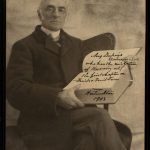
Auguste Dupuis, the son of merchant Jean-Baptiste Dupuis and Justine Letellier de Saint-Just, was born in Saint-Roch-des-Aulnaies on June 17, 1839. After completing his studies at Collège Sainte-Anne-de-la-Pocatière […]
Summary table presenting 456 varieties of seeds, made between 1938 and 1940 by Maurice Couture (1912-1957). Seeds encapsulated in 19 sealed frames, wood, glass, cardboard, adhesive tape, ink. […]
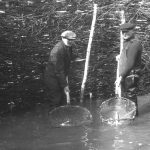
Weir fishing involved using fixed structures called weirs (fascines) made of branches woven between stakes. These structures led fish towards an enclosure where they were trapped by the […]
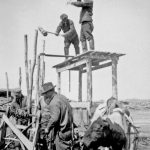
Men are planting wooden stakes in the ground at regular intervals. These stakes, which were often made of black spruce, formed the basic structure of a fish weir.
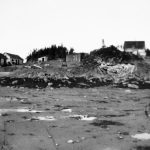
The Kamouraska Islands, including Île aux Patins, were places where people lived and worked. Local families exploited maritime resources for their subsistence and to support the local economy. […]
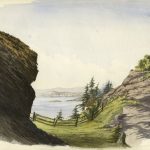
Kamouraska from Grosse Île, August 1874, Anna Dawson Harrington (1851-1917), watercolour. This work captures the magnificent view of Kamouraska from Grosse Île, with its precious glimpses of the […]