

Mary Ann Shadd Cary: Commemorating an Enduring Legacy
The second statue honouring Mary Ann Shadd Cary stands at the intersection of Chatham and Ferry Streets in downtown Windsor, just steps from the University of Windsor’s School of Social Work. Unveiled in 2022, the striking sculpture by artist Donna Jean Mayne of Fine Sculpture pays tribute to one of the nineteenth century’s most courageous and influential voices.
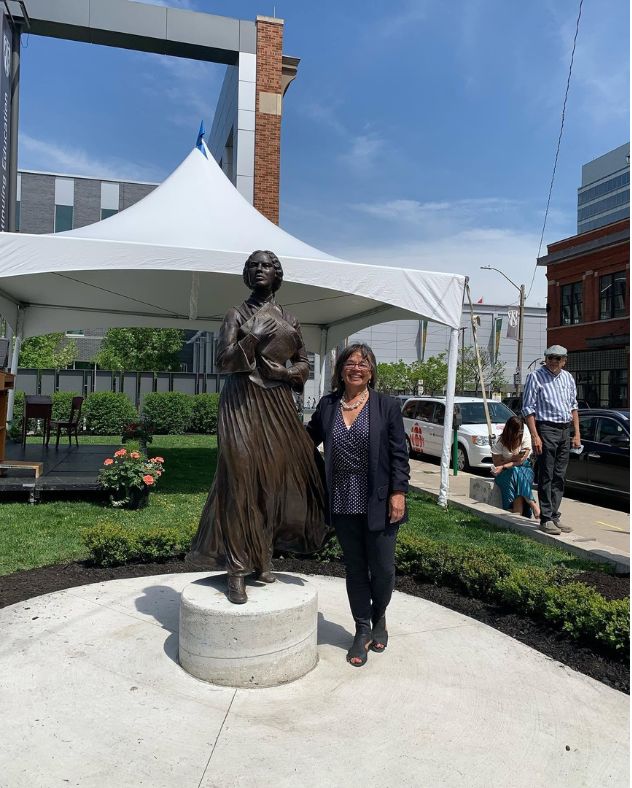
Shannon Prince, a descendant of the settlement, stands next to the Windsor statue of Mary Ann Shadd Cary.
More than a monument, the statue commemorates Mary Ann Shadd Cary’s unwavering commitment to education, equality, and justice while recognizing Windsor’s important role in the history of the Underground Railroad. Located in a place deeply connected to the journeys of freedom seekers, the sculpture stands as a powerful symbol of resilience, determination, and the enduring pursuit of freedom.
Windsor is not an accidental setting for this monument. Positioned along a vital cross-border corridor, the region was once a convergence point for freedom seekers and organizers connected to the Underground Railroad. Here, liberation was not only imagined—it was actively built. Shadd Cary was among those who transformed this borderland into a site of strategy, education, and empowerment.
When she arrived in Windsor in 1851, she did not simply seek refuge—she began constructing new systems. She established an integrated school and challenged the notion that freedom alone was enough without opportunity and self-determination. Her 1852 publication, A Plea for Emigration; or, Notes of Canada West, encouraged Black Americans to see Canada not just as an escape, but as a place to build independent futures.
That same year, she broke new ground by founding The Provincial Freeman, becoming the first Black woman in North America to publish a weekly newspaper. Through its pages, she advanced bold ideas—abolition, equality, temperance, and above all, self-reliance. She insisted that Black communities must speak in their own voices and define their own futures.
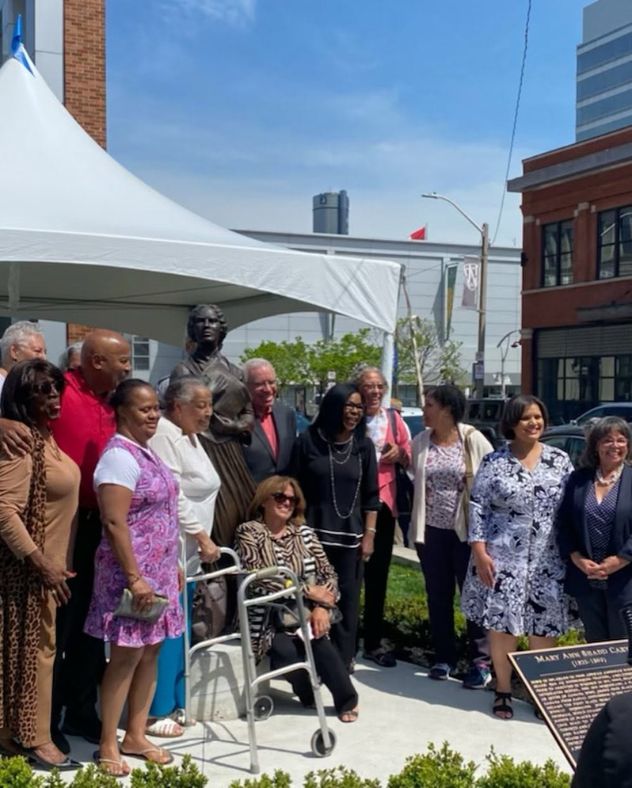
A group stands around the Windsor statue of Mary Ann Shadd Cary.
The Windsor statue captures more than likeness—it reflects movement. It invites viewers to consider Shadd Cary not as a distant historical figure, but as an active force in shaping communities across borders. Her life continued to evolve beyond Canada: in the United States, she became a Union Army recruiter, school principal, lawyer, and suffragist, continuing her lifelong pursuit of justice.
Today, the sculpture stands in quiet dialogue with the city around it—a reminder that Windsor’s streets once carried the footsteps of those determined to live freely, and of a woman who helped turn that determination into action.