

Leonard Atherton, Terri Pothier, Maureen Forrester
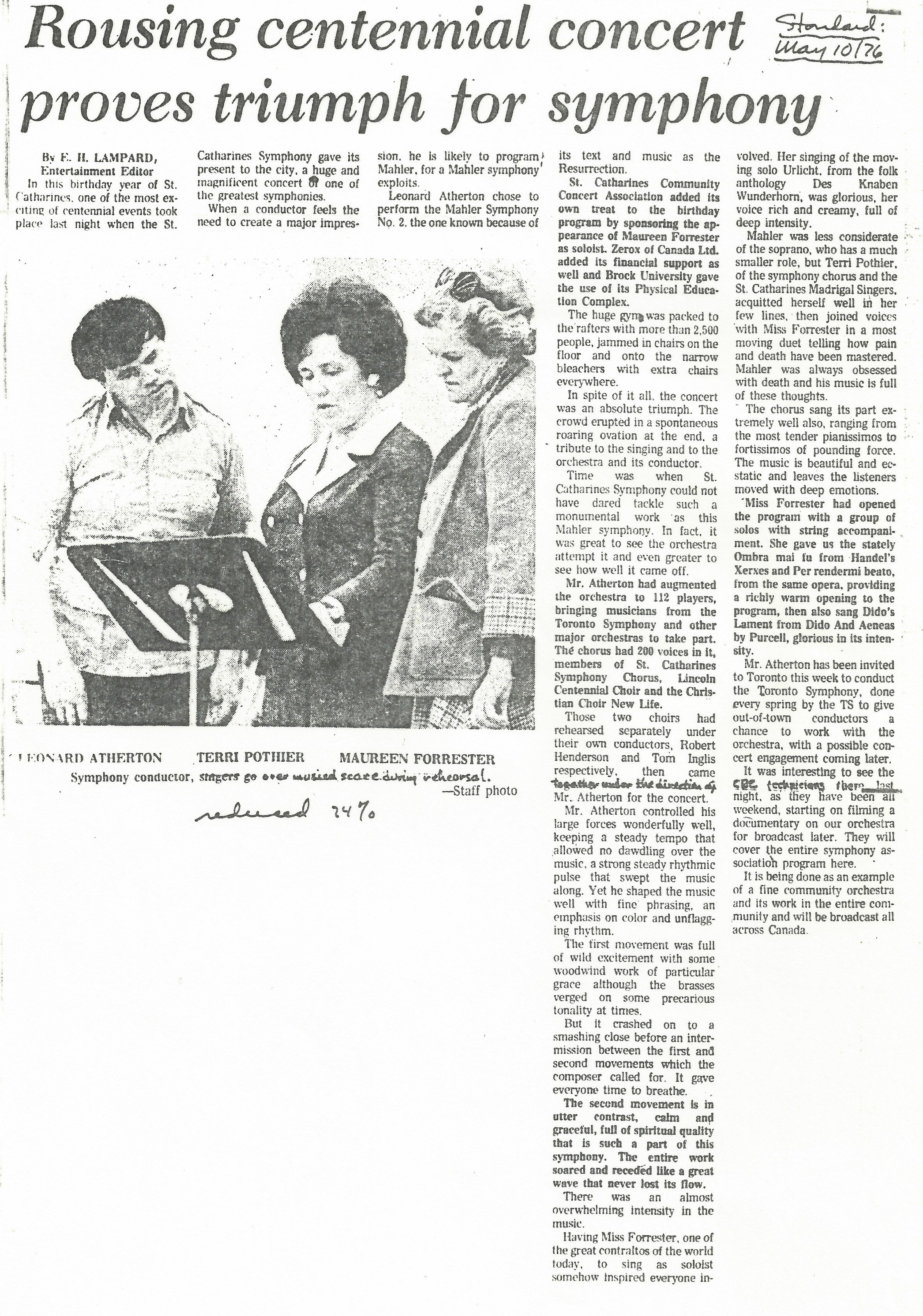
Photographer: Unknown, for the Standard
Date: May 10, 1976
Article printed in the St. Catharines Standard
Transcript of article
Rousing centennial concert proves triumph for symphony
By E. H. Lampard, Entertainment Editor
In this birthday year of St. Catharines, one of the most exciting of centennial events took place last night when the St. Catharines Symphony gave its present to the city, a huge and magnificent concert of one of the greatest symphonies.
When a conductor feels the need to create a major impression, he is likely to program Mahler, for a Mahler symphony exploits.
Leonard Atherton chose to perform the Mahler Symphony No. 2, the one known because of its text and music as the Resurrection.
St. Catharines Community Concert Association added its own treat to the birthday program by sponsoring the appearance of maureen Forrester as soloist. Zerox of Canada Ltd. added its financial support as well and Brock University gave the use of its Physical Education Complex.
The huge gym was packed to the rafters with more than 2,500 people, jammed in chairs on the floor and onto the narrow bleachers with extra chairs everywhere.
In spite of it all, the concert was an absolute triumph. The crowd was erupted in a spontaneous roaring ovation at the end, a tribute to the singing and to the orchestra and its conductor.
Time was when St. Catharines Symphony could not have dared tackle such a monumental work as this Mahler symphony. In fact, it was great to see the orchestra attempt it and even greater to see how well it came off.
Mr. Atherton had augmented the orchestra to 112 players, bringing musicians from the Toronto Symphony and other major orchestras to take part. The chorus had 200 voices in it, members of St. Catharines Symphony Chorus, Lincoln Centennial Choir and the Christian Choir New Life.
Those two choirs had rehearsed separately under their own conductors, Robert Henderson and Tom Inglis respectively, then came together under the direction of Mr. Atherton for the concert.
Mr. Atherton controlled his large forces wonderfully well, keeping a steady tempo that allowed no dawdling over the music, a strong steady rhythmic pulse that swept the music along. Yet he shaped the music well with fine phrasing, and emphasis on color and unflagging rhythm.
The first movement was full of wild excitement with some woodwind work of particular grace although the brasses verged on some precarious tonality at times.
But it crashed on to a smashing close before an intermission between the first and second movements which the composer called for. It gave everyone time to breathe.
The second movement is in utter contrast, calm and graceful, full of spiritual quality that is such a part of this symphony. The entire work soared and receded like a great wave that never lost its flow.
There was an almost overwhelming intensity in the music.
Having Miss Forrester, one of the great contraltos of the world today, to sing as soloist somehow inspired everyone involved. Her singing of the moving solo Urlicht, from the folk anthology Des Knaben Wunderhorn, was glorious, her voice rich and creamy, full of deep intensity.
Mahler was less considerate of the soprano, who has a much smaller role, but Terry Pothier, of the symphony chorus and the St. Catharines Madrigal Singers, acquitted herself well in her few lines, then joined voices with Miss Forrester in a most moving duet telling how pain and death have been mastered. Mahler was always obsessed with death and his music is full of these thoughts.
The chorus sang its part extremely well also, ranging from the most tender pianissimos to fortissimos of pounding force. The music is beautiful and ecstatic and leaves the listeners moved with deep emotions.
Miss Forrester had opened the program with a group of solos with string accompaniment. She gave us the stately Ombra mai fu from Handel’s Xerxes and Per rendermi beato, from the same opera, providing a richly warm opening to the program, then also sang Dido’s Lament from Dido And Aeneas by Purcell, glorious in its intensity.
Mr. Atherton has been invited to Toronto this week to conduct the Toronto Symphony, done every spring by the TS to give out-of-town conductors a chance to work with the orchestra, with a possible concert engagement coming later.
It was interesting to see the CBC technicians there last night, as they have been all weekend, starting on filming a documentary on our orchestra for broadcast later. They will cover the entire symphony association program here.
It is being done as an example of a fine community orchestra and its work in the entire community and will be broadcast all across Canada.
Leonard Atherton notes that this performance of Mahler 2 was a highlight of his time with the St. Catharines Civic Orchestra.
Theresa Pothier (Chorister, Board Member, Women’s Committee, Patron)
RECEIVED B.MUS from DALHOUSIE UNIVERSITY IN HALIFAX, NOVA SCOTIA
Received a scholarship from the Julliard School of Music and attended the Julliard School of Music in New York after Graduation from Dalhousie.
Moved from Halifax to St. Catharines in 1952.
My husband Hector Pothier, a lawyer in the frim “Coy and Pothier”, became manager of the St. Catharines Symphony and later President during the 1960’s. He passed away in 1974 when he was 42. After my husband passed away I taught Music at the St. Catharines Collegiate until I retired in 1986.
During those years I sang in the Niagara Chorus as a member and a soloist. In one memorable concert with the choir I sang with Marueen Forrester for the Mahler 2 Symphony presentation held at Brock University directed by Leonard Atherton who conducted both the Symphony and the Choir.
I also sang in a Quintet and a Bach Choir also directed by Leonard Atherton.